

I had the privilege of participating in the 2026 International Jerusalem Science Contest, run by Walder Science. The contest focuses on a different field of science each year, and this year’s topic was astronomy. The program consisted of seven sets of dual lectures—one on the purely scientific aspects of astronomy and one on the Jewish perspective. Each set was followed by a test, and the course concluded with a cumulative final exam. In addition, participants worked on an independent research project throughout the program.
At first, the course felt overwhelming, but I quickly grew to love it. The subject itself was fascinating, and the experience was made even more engaging by the teachers—Rabbi Yisroel Shaw and Professor Weintraub from Vanderbilt University—both of whom are incredibly knowledgeable. The lectures explored a wide range of topics, from gravitational lensing to calculating zmanim and leap years, which allowed me to see both the scientific and religious dimensions of astronomy.
However, the most incredible part was doing my own research project on how the universe will end. More specifically, I explored which predicted outcome is most likely—the Big Crunch, the Big Rip, or the Big Freeze. By examining observations such as supernovae, galaxy surveys, gravitational lensing, and galaxy clusters, I analyzed how the universe’s expansion has changed over time. The evidence shows that expansion is accelerating due to dark energy, suggesting that the universe will continue expanding for trillions of years. This points to a Big Freeze scenario, in which galaxies drift apart, stars burn out, and temperatures approach absolute zero. In contrast, the Big Crunch and Big Rip are not supported by current observations.
At the same time, I incorporated a Judaic component into my research by connecting these scientific ideas to themes of creation, boundaries, and completion. For example, Bereshit Rabbah teaches that the heavens and earth have limits, or “sikusim,” while the Torah itself is limitless. This idea parallels the Big Freeze, where the universe gradually approaches a functional limit over time. Similarly, in Yeshayahu, it describes the heavens vanishing and the earth wearing out like a garment, which echoes the gradual loss of energy described in this model. Bringing these perspectives together made the project especially meaningful, as it allowed me to connect scientific theory with deeper Jewish ideas.
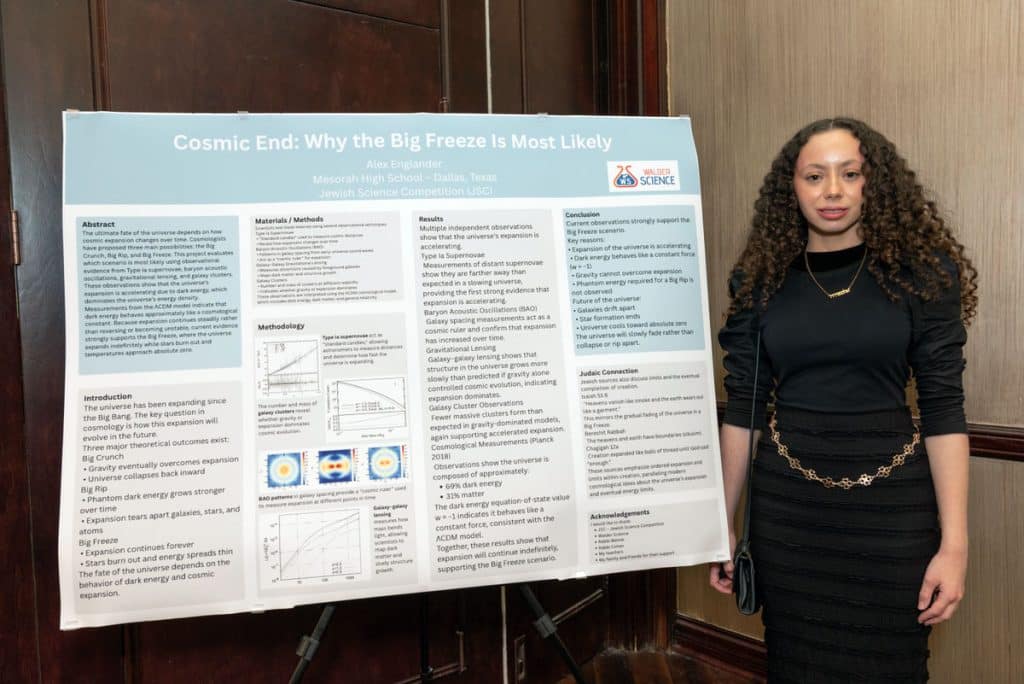
Working on this project ultimately became my favorite part of the course. It pushed me to read scientific studies and journals and analyze data on my own. As a result of this work, I was honored to place fourth in the contest. I was interviewed about my experience and invited to present my project in Chicago, the base of Walder Science, where I also received my award. Additionally, as one of the top five participants, I was awarded a future ten-day trip to Israel, where finalists will visit leading science and technology centers.
Overall, this experience has truly changed me. Learning such a complex and fascinating subject—and being recognized for it—has shown me how much I can accomplish. More importantly, it sparked a genuine interest in astronomy and scientific research, and I now see it as a possible path for my future.■
By Alex Englander
Student, Mesorah High School for Girls
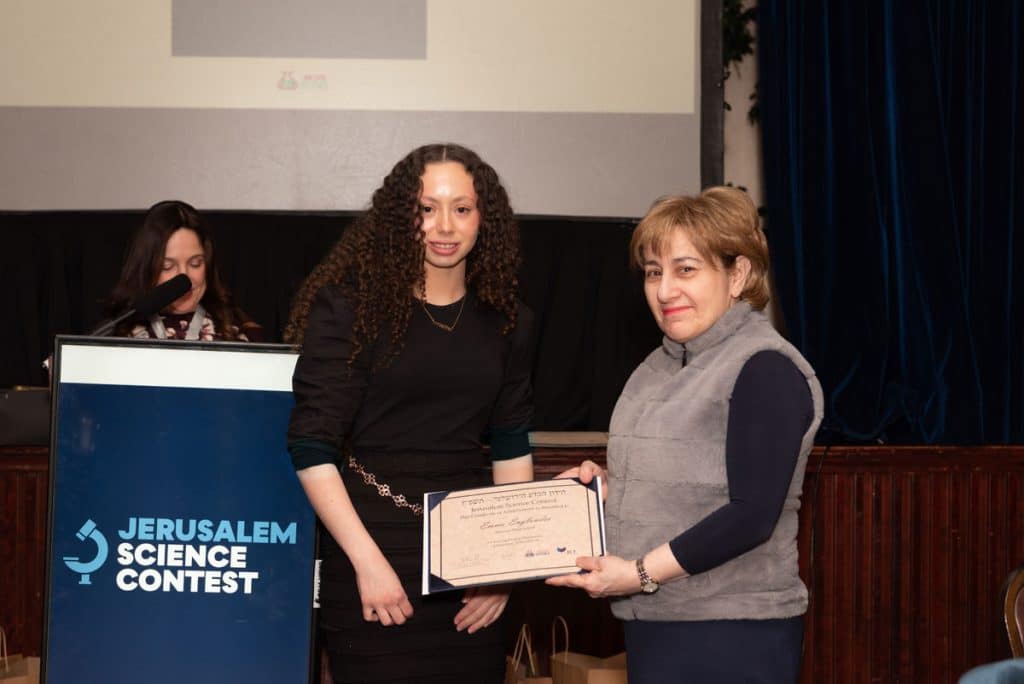
On behalf of Walder Science, I would like to express Mazal Tov to Mesorah High School on the extraordinary achievements of your student, Alex Englander, in the 5786 Jerusalem Science Contest! Alex has earned fourth place in the Girls’ Division and the JSC Israel Trip.
Walder Science is proud of Alex and all the JSC participants for all their efforts in our program. The JSC is an international competition with over 100 participants from the US and Canada, Israel, and Australia. The JSC is sponsored by Walder Science in partnership with the LEV Academic Organization- Jerusalem College of Technology (Machon Lev for Men and Machon Tal for Women) in Yerushalayim.
Alex presented at the annual JSC Culminating Celebration on Wednesday, March 18th at Walder Science 3050 West Touhy Ave, Chicago.
We are so honored to have students from your esteemed institution participate in the contest.
Mesorah High School clearly fosters a sense of academic and Torah excellence.
Sincerely,
Daniel Alkhovsky
Walder Science, Director