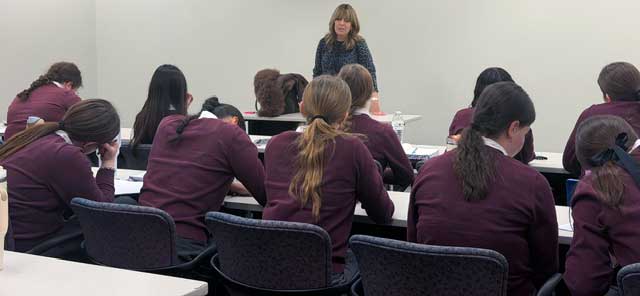


Mesorah High School for Girls had the profound honor of welcoming Mrs. Jen Airley, a speaker whose story touched every heart in the room. Mrs. Airley shared her journey of resilience and purpose through her talk, Healing the Nation and Beit Binyamin. Speaking with warmth and candor, she recounted the loss of her son Binyamin, a soldier who fell during the war in Gaza, and how his memory inspired the establishment of Beit Binyamin, a project dedicated to unity and healing. Through her message, Mrs. Airley conveyed the power of faith, strength, and commitment to the greater good, leaving students with a deeper appreciation for their role in building a stronger, kinder Jewish community.
We recommend listening to the audio and reading the words, together.
Thank you all for being here. Actually, I feel like now in Texas I have to say thanks y’all for being here. I just want to dedicate some learning in the zechut of Refuah Shaleima. You have a luach filled with… for those who need, Tefillot v’Yeshuot. But the three that were wounded this week, I actually know their families; two of the out of the three personally and I’ve been trying to do as much as I can for them. Noam Avraham ben Atara Shlomit. Etan Asher ben Devorah and Yuval ben Esther Yaffa. They should have a Refuah Shaleima Bimheira.
You know, I guess as the Rav initially just said, Hashgacha Pratis. Hashem is… the Master of arranging everything just so. Except we like to think of it as Hashgacha Pratis is like, oh, and it just worked out that this one said, and this one said, and Jen’s here, and… Oh, and I just made the bus. It just waited for me. Oh, and I just found that. Oh, the last shoe was my size, right? Like everything just works out just right.

Hashgacha Pratis is actually when we realize Hashem does exactly the way it’s supposed to be for me, not necessarily what I want. What Hashem knows is what’s best. Which sometimes is not the easiest pill to digest. We love it when it’s the great ending. We love it when it’s like the perfect, you know, fairy tale story. And there’s loads of those. And those are what makes the stories, those are what makes the book chapters and all the great… Right? But sometimes when you get to see Yad Hashem work exact the way it’s supposed to be, but even if it’s not… what I want, but what Hashem wants. It’s a real zechut to see Hashem’s hand directly involved.
I’m going to just share a little bit about that Shabbos that we heard about Binyamin’s… I don’t know if people know here. Maybe I should back up a little bit. I don’t know what was told, what was not. My Binyamin was killed in Gaza. We’re just getting close to his yahrtzeit, ה כסלו. And we have six children, Baruch Hashem. Binyamin is the second, but the first of all the boys, the big brother to the rest of the crew. And that’s what we’re living with now. But I want to share that Shabbos because I feel Hashem, had to really, really work worlds in order for it to be exactly what happened. So I’m going to share.
That Shabbos morning I was in shul and regular Shabbos morning, regular Krias HaTorah. Yaffe, hakol tov. After, in the middle of Krias HaTorah, I started getting very antsy, couldn’t stay in shul anymore, feeling like I just needed to leave. I couldn’t, I couldn’t, I don’t know. I couldn’t sit anymore. So I’m leaving, going home from shul. My little Chana, my 10-year-old, meets me on the way. She’s like, Mommy, you told me to come. I’m like, I know, but we’re going home. We’re going home. And we get home. I didn’t say anything till we get home and I’m crying and I’m crying and I’m crying and Chana come daven with me. We take out Tehillim and we’re davening and we’re davening. And I don’t know what to say to her. Like, I don’t know why I’m crying. I’m just crying. And she’s holding me and I just said, Chana, I just, I just, I had to say something. And I said, I just wish we can all be home for Shabbos together.
And she goes over to the bookcase and she takes out, sefer Mitzvat HaBitachon. She takes it out, she says, Mommy, I think you need this. I said, you’re right. Take it out, and we start learning together. I open up to the page. It’s so clear in my head. The one who trusts in Hashem is surrounded by His loving kindness. And this is what we’re learning. So we start learning. We’re reading together what it says. The way we turn to Hashem, whether it’s yirah, then that’s how He treats us. We turn to Him with ahava, that’s how He treats us. And this is what we learn.
I’m upstairs sleeping and my husband then comes running into the room quickly, Jen, come downstairs. I said, is everything okay? He said, no. I said, uh… Are the kids okay? And he said no.
I calmed down, hakol tov. We sit down, prepare a Shabbos seuda, regular Shabbos now, yeah? Go take a shluf. I’m upstairs sleeping and my husband then comes running into the room quickly, Jen, come downstairs. I said, is everything okay? He said, no. I said, uh… Are the kids okay? And he said no.
So I put something on, come out of the room, and I see the soldiers. There’s nothing to say. Sitting there and I’m sitting there and I said then to the soldier, by the way, I want to take a quick second. These soldiers that have to come, you know, last week we’ve learned about the three malachim that came to Avraham and Sarah and we know that there are three malachim why? Because each one has only one job. You can’t have one malach telling three jobs, yeah.
Now these malachim that come to our house, these ones that are now sharing news of the Malach HaMavet, they also only have one job. They also only know what happened just to Mishpachat Airley. They don’t know anything else. They are sent on one mission. So when I turned to her, And I’m sitting there on the floor and I said, Miriam, I want to give these soldiers, by the way, these malachim, dressed as soldiers, I want to give them a bracha. They have the worst job in the whole wide world to come and share such horrible news. We’re all going to give them a bracha now that they should be the ones to come knock on our doors to tell us the greatest news of the coming of Moshiach. A bigger amen. Yalla!
So I sit and I said, Miriam, what time did that happen? And she said the battle took place between 9.30 and 10.30 in the morning, which was Mamash when I left shul, when I couldn’t sit anymore. I said, Miriam what happened to his friends? But she’s only the Malach for Mishpachat Airley. She doesn’t know what happened to his friends. She only knows what happens to Binyamin Airley. She didn’t know. I needed to know what happened to his friends because I’ll deal with my pain. I can’t deal with other people’s pain. I can’t deal with his friends. You want to have a cheshbon with me, but don’t take it out on those friends also. But she didn’t know.
It took her four hours to tell me that her friends were fine, his friends were fine. You know it didn’t make any sense because they travel together. The four of them, there are four guys in each group. And they’re shoulder to shoulder, they don’t leave. How is it possible that Benjamin’s killed and everybody else is fine? I was so grateful. But it didn’t make sense.
Then I found out what happened and then it made perfect sense. You see When Binyamin was in the army, he’s this big tall, good soldier, he’s a strong dude, yeah?! He had this big machine gun. He was given this massive machine gun because he’s very tall, very strong, very broad, and amazing shooter. So he was awarded, him and his good buddy, Elia, were the only two that had this big machine gun for their group. He’s a paratrooper, great. And it happens to be. that when they were getting ready to go into Gaza the soldier Elia…When they were getting ready to go into Gaza now, these two are the ones with the Negev, yeah?
But now, Binyamin got a different job. When they’re training to go into Gaza, Binyamin is now given the job to be the right-hand man, the bodyguard of not his commander, not the commander on top of him, the commander on top of him, a very high up position. So now this is Binyamin’s job. And now as parents, that’s a very good story. It makes us very comfortable. because Binyamin and this commander are in charge of the all the equipment to make all the decisions all the paratroopers in north Gaza and they’re very well protected they have all the equipment so now they’re surrounded by soldiers and they’re surrounded by soldiers so we’re like he’s okay now Right, this group is, they’re pretty snug. Ele ma?
We found out that when they were getting ready to go into Gaza, or maybe when they went in already, I don’t know exactly the timeline, the other guy who had this Negev machine gun… broke his finger. So now he can’t use the machine gun. Who gets it? Binyamin. He’s so happy to get his gun back. So he has his machine gun. Perfect. That’s how they go into Gaza now. That’s what they’re fighting with. Perfect.
What happened that Shabbos morning? That Shabbos morning, there were three terrorists that were shooting at soldiers, and they ran into a house, and they’re shooting at soldiers from in there. The army, different groups are pulled to the scene. They’re throwing all the RPGs and grenades. Sounds quiet now. And then we hear that one of the soldiers from a different group, not even Binyamin’s group, so Binyamin’s group is called into the scene but they’re further behind as like this backup or I don’t know, but they weren’t called to actually fight but a different group was now on the side and one of their commanders, a soldier named Jamal Abbas, actually not even a Jewish soldier, Druze soldier, with his right-hand man, Shachar Friedman from Yerushalayim. they decide they’re going to go in and make sure the terrorists are dead.
Binyamin is watching what’s going on. He sees they’re getting ready to go in. Binyamin leaves his group. Says you can’t go in without me because you don’t have a Negev. You don’t have this big machine gun You don’t have neshek [weapons]. He says I’m going in with you. So he left his friends. He joins them and says I’m going with you to be your neshek and the three of them go into the house. One terrorist is hiding behind the couch and kills the three of them upon entry.
Now I’m also going to tell you that Elia, the one who broke his finger, came right back. Came back into the army. Came back into Gaza Friday night of Parshas Toldos Friday night of this event, but his finger wasn’t 100%. So Binyamin still had the gun for another few days. I’m also going to tell you that when the Binyamin went into this house and they’re throwing all their grenades, Binyamin slipped. Falls on the floor, like is on the floor and a grenade is right next to him. and now Binyamin he’s like Mr. Cool. He gets up he leaves the house. The grenade blows up. And Binyamin then goes back into the house.
So now that’s not the Hashgacha Pratit. That’s not Hashem saying, no, no, not you, not you, not your buddies, not your friends, not Elia. Binyamin Airley. Not that that makes it so good. But we understand Hashem chose Binyamin. And now I’m going to tell you that when I was davening that Shabbos morning, first of all, it took me a few weeks to realize that she didn’t say that’s when Binyamin died. She said, the battle took place between 9.30 and 10.30 in the morning. Meaning when I was crying and I was davening, I didn’t know I was davening for his life. I didn’t know that he was still alive. I didn’t even know he was dead. I didn’t think anything. I’m just crying. But I realized that the whole time he was alive. And I was fighting for his life.
But now I’m going to ask you this. Yeah? Did my tefillah fall on deaf ears? Did Hashem not answer my tefillahs? Does He ignore a single tefillah? We know Hashem doesn’t ignore a single tefillah. Every tefillah is answered. So now I can tell you, because I’m sure you’ve heard the horror stories of October 7th. You have unbelievable, I see you’re incredibly connected. I see you have all… Really, signs of it. I feel like I am…
I described what I felt like when I came to America this trip I started crying when I landed like in a foreign land I’m so far from home and then I come to places and I see the names of hostages, I see soldiers, I’m like, okay, they’re with me. I’m not so far from home. I’m surrounded in good company here, people who connect to Am Yisrael.
In Eretz Yisrael. But we know that not a single tefillah goes unanswered. And how do I know this? So you know the horrors. I am zoche to know how Binyamin died, Not everybody can say that. I’m zoche to know that he died instantly. Not everybody can say that about their soldier. I’m zoche to have his belongings. I even got…his tefillin was lost, and the unbelievable Hashgacha Pratit of how we found his tefillin, and now Baruch Hashem, my bar mitzvah boy Yaakov is okay to use his tefillen. I’m zoche to bury him when I wanted to bury him and not have to wait on line behind people because of all the… These are not things that we take for granted in this war.
I’m also zoche that if Binyamin was going to go up to Shemayim on ה כסלו, I’m zoche to know he went to Shemayim al-Kiddush Hashem. Not by, I mean, even friendly fire, unfortunately, is also Kiddush Hashem, but it’s not the way Binyamin wanted to go. Binyamin wanted to go protecting Am Yisrael. And he was blessed. And I as a mother, as a mother, I’m so happy to know that my son is blessed. In fact, when they pulled him out, His buddy Yonatan said that he takes him out and he says Shema with him and he says, Binyamin had a smile on his face. And Binyamin was doing exactly what he wanted to do. You know, before the war, he told us, if I have to die, that’s what I have to do. It’s not really what a parent wants to hear, but it’s also what a parent wants to hear. That is what is the most important thing about children. The most important is Am Yisroel and Eretz Yisroel.
We say with Sorah Imeinu, yeah, we’re parashat Chayei Sorah. We say Sorah. What happened? We know that last week’s parasha finishes with the Akeidah and Sorah dies. And obviously we have the Smichut HaParshiyot. We know that it was the… Akeidah that caused her death one way or another, so many different understandings. But we also know, there’s actually, we also know that… Sorah’s, eich shehu, right? The Akedah caused her death, but what? It was her day to die. She could have died any which way. It was going to be that taarich. That’s her day, wherever she was going to be. And nachon. B’Akeidah it was.
And Avram could have said, so then what was it worth for what so now look I didn’t have to I didn’t even fulfill i didn’t do the Akeidah, and I lost Sorah. And he could have been upset. He was not upset. We say in Ma’ariv, והסר סטן מלפנינו ומאחרינו. It’s not that the satan, it’s not like I regret, he didn’t regret. Right? The Satan achareinu is to regret what we did. He didn’t regret what he did. That’s a Satan that says, maybe you shouldn’t have done that mitzvah. Maybe you shouldn’t have done ratzon Hashem because look what happened. No. Avram understood, that this was Sorah’s taarich.
But I heard a beautiful, I heard such a gorgeous word about the Piazetzna, so I’m sorry, I know you want to hear about Binyamin, but I share Torah, that’s how I relate to the matzav in our lives. Piazetzna says, we know about Sorah, we see 100 years, 27, you’ve learned all this word, right? All her years were equally good. How is that possible? She’s 90 years old, and waited. We know people, unfortunately, 20s, 30s, 40s, and they’re still barren, and every single month is so painful. What can we say was all good? We had beautiful ideas. She saw the good. She takes the good. She extracts the good. She focuses on the good. So much to learn from that.
I’m surrounded by Nashim Tzidkanios and now I’m going to say this. I always, I like to focus on the good. I like to see all the bracha in it, and I do. And this is how I survive. By seeing the shefa tov that Hashem blesses us with. But the Piazetzna… Yesterday I heard this, I was blown away. And only the Piazetzna can say this because he wrote, he was in the Shoah and he was killed in the Shoah and he was writing this then. And he said that when Sorah Imeinu died, it was because she said, Hashem, I’m going to die. Because you know what? Sometimes Hashem, you give us sorrows that are too hard. We always say, Hashem never gives us something too hard, it’s too much. But Sorah is saying sometimes that tzarot are too much. Hashem, I’m going to give my neshama to you because I need you to know, Hashem, that sometimes it is too much. And now I’m showing you Hashem, sometimes tzarot are too much. And we’re supposed to say, enough Hashem, too many tzarot. Enough?
So I have a little chutpah now with Hashem. I love Hashem. I talk to Hashem all the time and sometimes I feel bad that I have chutpah. But now I say, enough Hashem. Sometimes I’m very nice and I say, please Hashem, no more. Please Hashem, fulfill your promises. You promised that we’re going to have all these nevuot. You promised Hashem, please just… and sometimes yeah sure no it’s time. It’s time that all these are not here because they get all the things that they need, all the yeshuots and all the refuots.
But this is where you come in. This is where you’re the nashim tzidkanios and this is where you should also know that your tefillott accomplished all of that. I’m also here to tell you that every tefillah that you have… I think I need to explain the nisim v’nifleot that we are witnessing in Eretz Yisrael. We’re mamish mamish witnessing nevuot coming true in front of our eyes. Not just the kibbutz galiyot, that Yechezkel and Yishaya and Yirmiyahu and Zachariah. These are nevo’ot that were… spoken about thousands of years ago and we are witnessing.
We are also witnessing other nevuot. Right? We say in Yirmiyahu talks about that the nevuot, that the vineyards are going to be planted by Harei Shomron. I see that. We planted vineyards in the Shomron in honor of Binyamin. Binyamin planted vineyards before he died. We also say that in the Arava, in the desert, Yeshaya talks about that the vineyards are going to go back to Arava, to the Garden of Eden. We haven’t planted vineyards there. The vineyards are being planted in the wilderness, in the arava, in the deserts. These are nevuot. We’re witnessing them.
Your tefillot are accomplishing miracles. What, 100 plus ballistic missiles are coming at us? We get to come outside of the room dancing. Singing Mizmor L’toda. The soldiers up north, soldiers down south, soldiers… Each one, I promise you, every soldier can tell you miracles that happened to him. These are your tefillot. These are what your tefillot are accomplishing.
So I’m also here to say that if you’ve been davening, daven more. It’s working. If you’ve been learning and working on your midot and doing all sorts of chesed, it’s working. Keep doing. I know it’s been a long year. I know we can get tired, we can feel like it’s been so long, it’s not the same cheishek, it’s not the same ometz, it’s not the same power and strength, but it must be. The war is still going on. So it has to stay strong. Because until this war, until all the… [school bell rings].
I’m sorry. If… Okay. If you have to go, I understand. But if you feel that… We cannot feel that we’re getting tired. I always say, what if the soldiers were to say we’re tired? Oy va vay lanu. And what if the social workers were to say I’m too tired to handle the children’s problem? Oy va voy. What if the… We can’t. So neither can you. I know you’re far away from Eretz Yisrael, but I know you’re really not. Everyone feels Libi Bamizrach. Everyone feels incredibly connected and everyone has to stay that way. You should just really, really, really know that every ma’aseh chesed, every teffilah, every Tehilim, every limud, all the things that you’re doing are really accomplishing, worlds. So please keep it going and if you thought that you’re a little running out of steam find the steam inside and push harder and then when you think that that’s your goal push harder
Because something else we’ve also learned is that we have a lot more koach than we think we have. I can tell you that personally, I…This is not my job. I mean it became my job. I’m like an exercise teacher. I give some parasha class. I do my little thing at home and I like to stay home. I’m completely out of my comfort zone. I don’t like leaving Eretz Yisrael. I don’t like leaving my family. I don’t like public speaking. I don’t like having to put myself out there. This is so out of my comfort zone. But this is what I’m doing for Am Yisroel. I’m not doing it for myself. I’m not even doing… I’m doing it for Am Yisroel. And this is what I have to keep telling myself. I keep telling myself, Jen, you’re going to America. For Am Yisroel. Jen, you’re going to speak, you’re going to lose sleep, you’re going to not eat, whatever. For Am Yisroel.
This is our job right now. This is what… everyone in Eretz Yisrael is doing and this is what you then around the world need to do, and they are. But I’m just here to ask you to push a little harder. Because, so far it’s Shabbos in Eretz Yisroel which means now we know over here we’re not getting the Beis Hamikdash and Moshiach before Shabbos. Because, otherwise they would have heard about it before Shabbos over there. And if Moshiach didn’t come yet, that means we’re not done. That means we have to keep pushing.
I don’t know, I’m a runner. So I always picture, you know, I ran a race with Binyamin and… and I didn’t now talk about so much about Binyamin. I ran a race with him and when we run, we were running a race, he’s much faster than me, so he was like pushing me uphill. If you want to go faster, you can go. And he said, no, no, I want to run with you. Anyway, b’kitzor, we’re running fine. We get towards the end and he of course has a lot more strength than I do and I’m getting tired and he’s still wanting to go faster. B’seder, can we start sprinting? We’re almost at the end. I’m like, it’s too early. sprint yet. And he said, again, a little bit another kilometer later or a kilometer, 20 of 21. I don’t know. That doesn’t mean anything to you. But whatever.
We’re getting closer to the finish line. And he’s like, can we start sprinting? I’m like, no, not yet. If you start. pushing too hard too early, you’re going to run out of steam. So I said, Binyamin, I’ll tell you when we start sprinting. Because I know the course. You turn, you see the finish line. Great. When you see the finish line in front of you, that’s when you sprint. Yeah? Ready? Now, hit the gas. Time to fly. I feel like this is where we are as a nation. I don’t know, maybe in Chutz L’Aretz you don’t see it. I see the finish line. I see that we’re so close.
To that moment we’re feeling I don’t know. We just keep thinking like no is the Beis Hamikdash gonna fall already, Yalla. Like it’s this the last time I’m gonna see the Kotel. It seems it feels so close, which means it’s time to push hard. Kick the gas and floor it and just zoom. Whatever kochot you have, I beg to just use it. We’re really almost there. Really, what does really mean? Does it mean two days, two years, 20 years? But it’s sooner than it’s ever been. And that’s where our kochot have to be pushed to. To know what our kohot really are, to use them tov and to see all that comes of it. B’ezrat Hashem.
I will also, I feel like the director of Beit Benjamin, is going to be upset at me if I don’t mention this, even though now I’m really past time. I’m so sorry, but I want to just share something that we have done. And as Mishpachat Eireli, so many beautiful initiatives are done all over Eretz Yisrael, and also in honor of Binyamin, more vineyards are planted and kollels have started, barbecues for soldiers, I mean so many things.
One thing that we have done, which the reason I’m sharing it is because not only is what we’ve done amazing, but why we’ve done it. And that is also a message that I’d like to share.
Is it okay that I… I’m done. Two minutes. I’ll tell you this. Talk about Hashgacha Pratis?! Two and a half years ago, my husband and I saw a house in Tzfat and we loved it. Now… It’s a little nutty of a story because we weren’t looking for a house. We had no money for a house, but we saw it. We loved it. We decided to buy it. It’s the most crazy story in the whole wide world. We borrowed money from every different place possible just to build this and we decided we’re making Airbnbs. It’s gonna be a great parnassa for the children and then they’ll have it and it’s gonna be wonderful. Great. Airbnb’s in the old city of Tzfat. Beautiful views, pampering, we’re gonna make it the fancy one so people from America like to stay in there, amazing. And we started construction on it. It was supposed to be finished by this past summer, not this past summer, the one before, and of course, construction is running late. Great.
I’m telling you this because we could have easily said, we’re done. Hashem, you knocked us down. You gave us the worst news possible. And we’re finished. And it would have been okay. We were allowed to say that. But instead we’ve turned to Hashem and said, we’re not asking you lama [why]? We’re asking you l’ma [to what]?
War breaks out. Everyone stops. No work and nothing’s doing. And then six weeks later, Binyamin is killed. Nothing doing. Then I decided I come home one Shabbos a few months later and I turned to my husband I said listen I came home from shul and I have a nice idea. It’s crazy thoughts going to my head in shul. What can I tell you? I come home from shul and I said Rob? I want to open a yeshiva for non-religious soldiers.
These soldiers in the war are putting on tefillin and they’re putting on tzitzit, they’re singing, and they don’t know the first thing about Shabbos. They don’t know the first thing about kashrus. I know it seems so crazy, but it’s true. So I want them to come out of… this crazy world that they’re seeing miracles and come and now start learning about Torah. Start learning about Yiddishkeit because Yiddishkeit is so sweet. Let them see how delicious it is.
So he says, you think they’re going to come out of war and then just sit and learn. So I said, he says, like, they need therapy. Great, give them therapy also. He says, they need a spa. They need pampering. Great, we’ll give them spa pampering. Anyway, back and forth, back and forth, we realize this is why we have the house. And now this is what we’re turning the Airbnbs, that we had built, into.
And we made this house now a retreat center for soldiers. And for all those directly affected by war, somebody whose house was destroyed, a single mom and kids, miluim families who haven’t been together with their kids. We hosted bar mitzvahs, all sorts of things, and this is what we’re doing.
I’m telling you this because we could have easily said, we’re done. Hashem, you knocked us down. You gave us the worst news possible. And we’re finished. And it would have been okay. We were allowed to say that. But instead we’ve turned to Hashem and said, we’re not asking you lama [why]? We’re asking you l’ma [to what]? What do you want us to do now, Hashem? How can we give more to Am Yisroel? How can we help others with our pain? And that’s really what Beit Binyamin is. Not only is it in and of itself the greatest conduit of chesed to give back to people who are suffering in trauma and in pain, but we are able to now help those people. And we’ve decided that because we can, davka, because we want to, and davka, because it’s needed. And that is the story of Beit Binyamin.
We should all be zoche through pain to rise up, and we should never know from any, but understand that from every hardship you can always come back much stronger, as a person, as a family, and as an Am. ■