



Dear Parents,
Below are just a few highlights from our very busy week in General Studies.
Mr. Dukes’s 9th- and 10th-grade students have been researching countries in Central and South America. Working in partners, students researched and created slideshow presentations to share with their classmates throughout the week. Their research included each country’s physical and political geography, industry, and history. I was impressed with the presentations—informative, well-organized, and very well done.
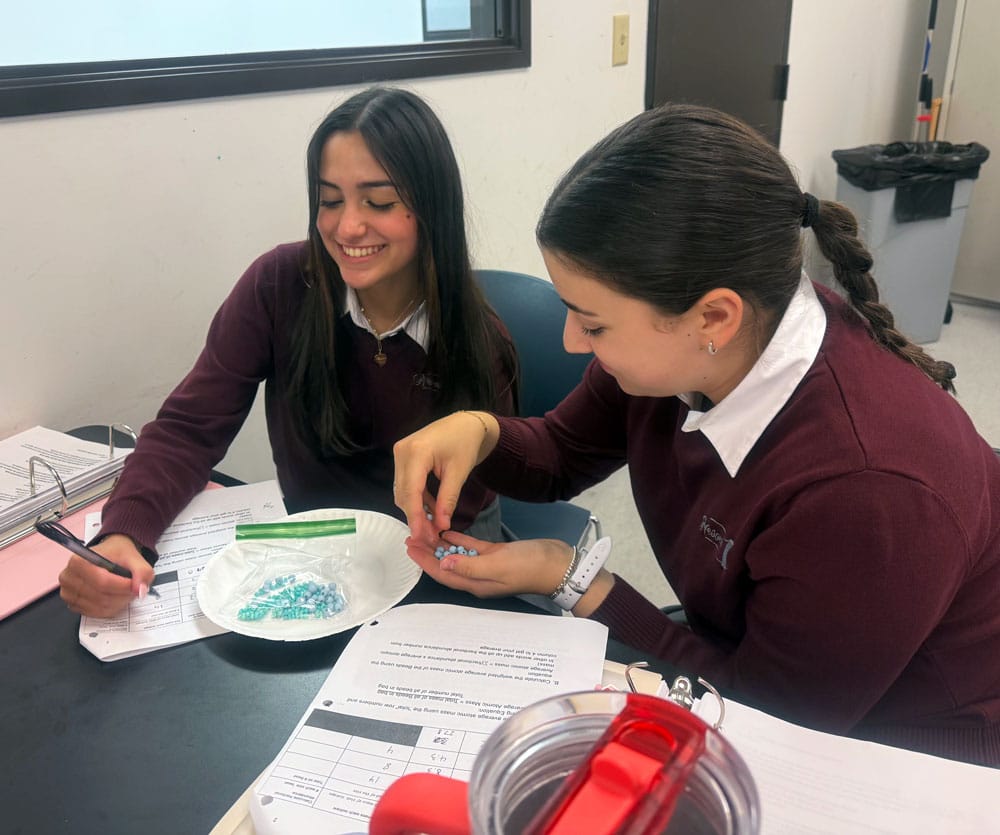
In chemistry, Mrs. Goldfeder introduced Unit 2: The Periodic Table Over Time. Students participated in an interactive lab, Beads as Isotopes Discovery, where they used beads to calculate the weighted average of the masses of an element’s naturally occurring isotopes and see how that data is represented on the periodic table. Mrs. Goldfeder’s use of hands-on labs helps students grasp complex concepts—an instructional strategy that is both engaging and highly effective.
Our 11th- and 12th-grade students in Mrs. Pace’s English classes continue deepening their knowledge and use of AP Literature terms. While reading Frankenstein, Mrs. Pace facilitates learning through Paideia Seminars—a structured approach in which students read a core text and engage in open dialogue to examine ideas and viewpoints, developing critical thinking and communication skills. Rooted in the Socratic method, this approach fosters a deeper understanding of complex ideas through discussion. Thank you, Mrs. Pace, for guiding students to think critically and deeply!




Miss Jimenez’s science students wrapped up Unit 1 with an exam this week. She shared that students performed well and that she is pleased with their progress. Unit 1 provides the foundation for understanding the natural world by introducing key concepts such as matter, energy, and forces, while applying mathematical principles. This prepares students for more advanced studies and future careers in STEM fields.
In biology, Mrs. Yurowitz introduced DNA. Students were fascinated by the idea that a molecule so small can determine not only our physical features but also be used in practical applications—such as ancestry research, family identification, and law enforcement. Of course, they are especially eager to learn about traits like hair and eye color. In the words of one student: “This is cool.”
Have a wonderful weekend!
Dr. Joleta Gallozzi
General Studies Principal
Mesorah High School for Girls